
Monday, August 13, 2012
FESTIVAL COUNTDOWN: The importance of demos
An important message from Brendan Milburn, composer of Sleeping Beauty Wakes, about why the writers need to have demos at the Festival.

Thursday, August 9, 2012
FESTIVAL COUNTDOWN: From the novel to the classroom to the stage to the Festival
A post from Beth Turcotte, bookwriter of The Circus in Winter, about where the show came from and its connection to arts education.
Over the next two
years concert performances took place on campus, at the Peru International
Circus Hall of Fame and at Drury Lane-Oak Brook, Chicago, Illinois.
This past fall, Circus had a fully realized production at Ball
State University. This production was also an American College Theatre Festival
entry. Circus was selected as a regional participant for ACTF at the
University of Illinois in January 2012 and recognized with eight Kennedy
Center/ACTF Awards including Outstanding New Work this past May.
The Circus in Winter is the product of an immersive learning project developed
with support from the Virginia Ball Center, Ball State University in the spring
of 2010. The class consisted of fourteen remarkable students from five
different disciplines from across the campus. Over the course of three
months, the students adapted the novel, The Circus in Winter by Cathy Day, into
a musical. Now, anyone who has ever directed, produced or taught, knows
that some days working with a group of creative folks is like herding cats.
Then comes the day when you figure out which student is Antares, the
anchor, and you become Ben Hur taking the curve with all four white horses
perfectly lined up.
 |
| Image from the Ball State University production |
Although the
students have all graduated and moved on to new adventures, they will forever
be linked with this project. Ben Clark, composer and lyricist, remains with Circus and will anchor it around its next curve.
The Circus in Winter is arts education at its best.
FESTIVAL COUNTDOWN: Directors and Music Directors announced
 We are so excited to welcome many of this year's directors and musical directors for the Festival!
 Bonfire Night will be directed by Sam Buntrock (Tony nominated for the revival of Sunday in the Park with George) with music direction by Kimberly Grigsby (Spring Awakening).
Funked Up Fairy Tales will be directed by Jerry Dixon (who directed Red Clay in '10 and Barnstormer in '08 for us) with music direction by Steve Marzullo.
Nobody Loves You will be directed by Michelle Tattenbaum who directed its premiere at The Old Globe.
Sleeping Beauty Wakes will again be directed by Rebecca Taichman, who also helmed the McCarter Theatre and La Jolla Playhouse productions.
Southern Comfort will be reunited with the director and music director from their CAP21 workshop production last fall, Tom Caruso and Emily Otto, respectively.
Triangle will be directed by Meredith McDonough, who is directing a reading of it this weekend at TheatreWorks Silicon Valley.
The rest of the directors and music directors will be announced in the coming weeks.
Click here to read playbill.com's article about our creative teams.
It is so great to have so many people returning to the Festival and to welcome many new faces as well!
Monday, August 6, 2012
FESTIVAL COUNTDOWN: Welcome back...
A special video blog entry from Brendan Milburn, composer of Sleeping Beauty Wakes, who is returning to the NAMT Festival after last presenting Striking 12 in 2004 and Watt?!? in 2011.
Help out this year's writers, like Brendan, by supporting our RocketHub campaign to raise $5,000 to make all of the demos for this year's 8 songwriting teams.
Help out this year's writers, like Brendan, by supporting our RocketHub campaign to raise $5,000 to make all of the demos for this year's 8 songwriting teams.
Thursday, August 2, 2012
FESTIVAL COUNTDOWN: The Origins of BLEEDING LOVE

I’ve
written a musical and I think hope pray know it’s
amazing... Now what? For me, this question seems to surface when
nearing the completion of the first full draft. Maybe it’s my brain putting off
those final bits of work – before the rewriting begins, of course.
Or maybe, for the first time, so much of the show is actually written, it
finally seems real. It exists. Not just in my head where it’s been
for some time, but on paper. It’s suddenly possible to visualize actors
stopping the show with the songs, to imagine audiences laughing at the jokes or
being moved (to tears?) by the characters and the story.
Bleeding
Love began with a desire to write
something that offered audiences a huge emotional experience. I
brainstormed a list of my most peculiar fascinations – anything that ever
elicited a powerful and preferably mysterious response in me. This
included Brooklyn brownstones, the sound of a cello, Klaus von Brücker from the
films of Bruce La Bruce, my childhood piano teacher, the fairytales of Oscar
Wilde, my mother’s greenhouse, the line art of
Aubrey Beardsley, longhaired men and punk goddess Nina Hagen, to name more than
a few. Hoping this unusual combination of elements might have a similar
effect on others, I fashioned them into a narrative, but the result was so
rarified, it seemed no one but me could possibly appreciate it.
Harris
(lyrics) and Art (music) initially rejected my “rose story.” “We want to
write something commercial,” Harris said. But as the three of us
continued to talk about it, Bleeding Love’s very strangeness seemed to
be its greatest selling point. And commercial or not, it was a
show all three of us wanted to see. A year later, when we sat down in a
New York rehearsal studio to read it through beginning to end, it was still
starkly unique, but our collaboration had transformed it into something bigger,
something more accessible, and – dare I say it? – something commercial.
Now what?
Bleeding
Love was a finalist for the Richard
Rodgers Award and now, the first public performance of any kind will be at
NAMT’s Festival of New Musicals. This is an extraordinary opportunity to
present a show with a first-rate cast and director before an industry
audience. Because of this, Bleeding Love has the best possible
chance of finding the right developmental path, whatever that may be.
NAMT’s guidance will allow us to find the right home and the right audience for
our show. And personally, it’s a thrill and an honor to be in the company
of an amazing roster of writers whose work I have loved and admired. Or
at least read about on playbill.com.
The crazy
list that started this journey did not include writing musicals, but it should
have. For me, NAMT’s recognition and support is a dream come true.
Now what?
Thursday, July 26, 2012
New Works In Progress: LOVE STORY
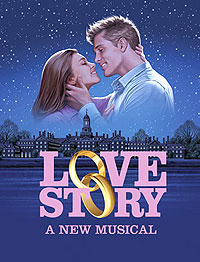
Inspired by Erich Segal's best-selling iconic novel, and one of the most romantic films of all time, this life-affirming musical will have you remembering the first time you fell in love. There was music in the air—and a feeling so powerful that no one and nothing could take it away. That music is in the air again with Love Story, the Musical. When Oliver Barrett IV wanders into a library in search of a book, he discovers Jenny Cavilleri. They came from different worlds. He was a Harvard man, she was Radcliffe. He was rich, she was poor. But they fell in love. This is their story. A celebration of love and life, Love Story, the Musical will win your heart... and it may just break it.
How does Love Story differ from the movie and the novel?
Other than the most obvious difference that it is a musical, the Erich Segal story itself is intact and holds all the memorable moments from the book and the movie. Enthusiastic fans may notice some differences that help the movement of the story in this staged version (for instance, the compression of two scenes into one to help the narrative flow). This very emotional story lends itself so well to being a musical and particularly with Howard Goodall's delicate and evocative score.
How has the show evolved from Chichester to the West End to the U.S. premiere?
The essence of the original Chichester production remains. The writer Stephen Clark and composer Howard Goodall, along with the original creative team honed and refined their work for the move to London by cutting and adding both musically and literarily. The Chichester stage was an apron stage and a very intimate audience/performer experience, so the production also faced the very practical challenge of moving to a proscenium theatre. The loss of intimacy was a concern, but it didn't lose any emotional impact in the move—if anything it enhanced it.
What are you and the writing team hoping to work on while preparing for this production?
Festival Show Update: LIZZIE BORDEN

What was the audience's response to Lizzie after the Festival?
Audience responses have been incredibly gratifying. At the Festival, the tremendous show of support from the NAMT community was overwhelming—there were so many great moments. One of our favorites: an older man came up to Alan saying "You know what you've done here, don't you? This is Tommy meets Sweeney Todd!" Well, besides the fact that we love both of those and it's very flattering to be compared to them, we've always seen Lizzie as somehow situated exactly between those two worlds, so for this guy to get that was a great sign for us that we'd succeeded.
What has changed in the show since the Festival?
We've made a handful of tweaks and a couple of bigger changes. There are 2 whole new songs. One is a solo for Lizzie, "This Is Not Love," near the beginning of the show that we hope gives the audience a clearer idea of where she's starting from emotionally, psychologically. We also replaced the ending with a less ambiguous statement of Lizzie's apotheosis into legend, "Into Your Wildest Dreams." And we have officially dropped "Borden" from the title—the show is now called simply Lizzie.
You recently had a change of commercial producers. How did that come about and what was the decision process like for you to decide to change things up?
Subscribe to:
Posts (Atom)